
Could Germany Have Won World War 1? Yes
Germany had two paths to victory in World War I

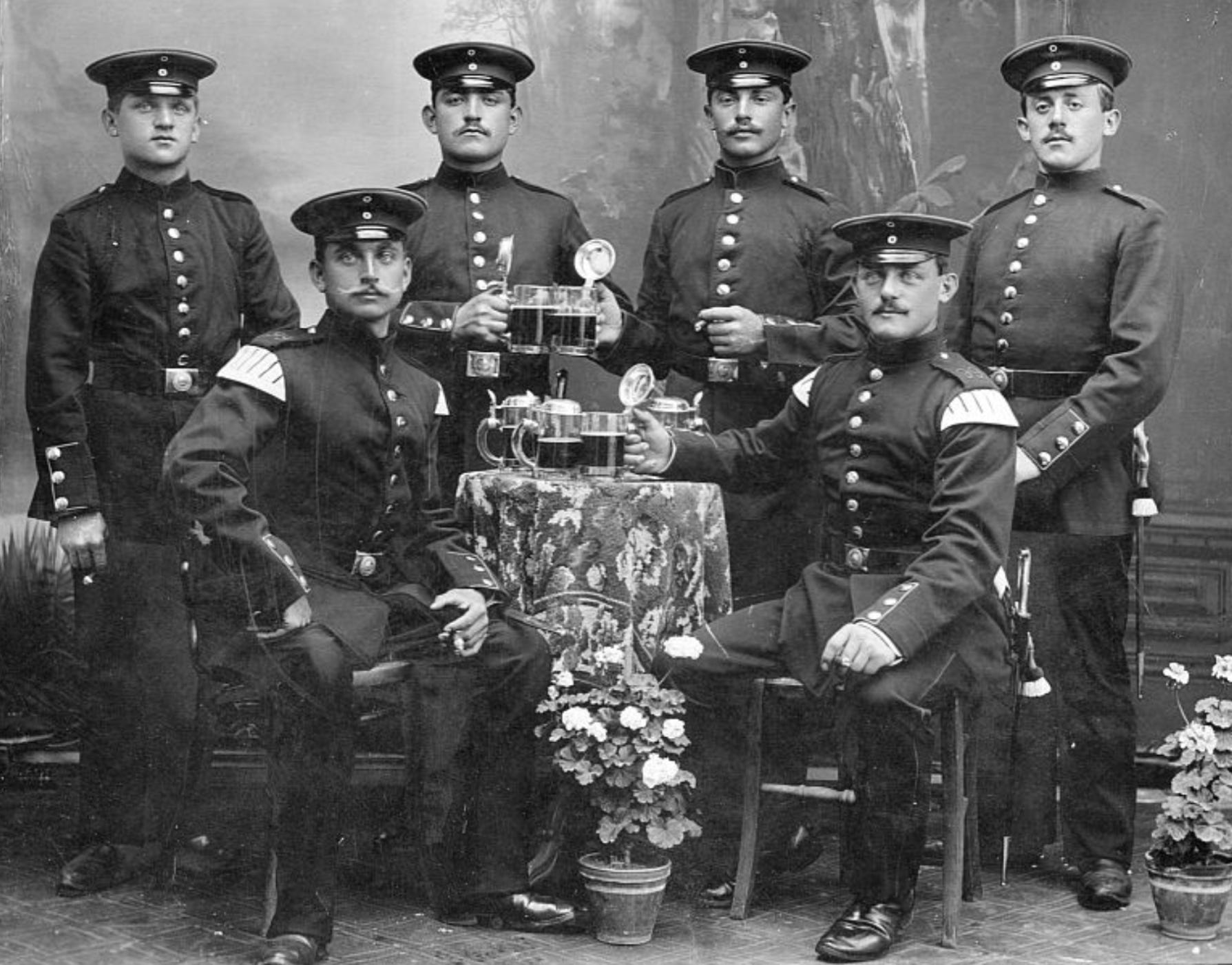
(A group of ordinary Imperial German soldiers, 1898 - Swabian Regiment)
World War I, unlike World War II, was a war which Germany could have won.
The initial phase of the war, August and September of 1914 represented the first obvious chance for German victory. A great many books have been written about the Schlieffen Plan and how close German armies came to capturing Paris in early September, 1914.
In brief, the German war plan devised by Graf von Schlieffen was both clever and subtle and the French played into the German strategy just as Shlieffen had predicted. If the German High Command had kept Schlieffen’s plan intact, Germany would have almost certainly have taken Paris by September 15 and the French would likely have sued for peace. Britain wold have withdrawn its small expeditionary force and Russia, left on its own, would have probably ceased its offensive as well. The Ottoman Empire would never have joined the war (as they were still hesitating about allying with their long-time enemy Austria until October 31 in our world). World War I would have ended in a peace treaty in late 1914 and it would not even be called World War I, it would be called something else.
This didn’t happen.
However, Germany still could have won the war even after the initial attack on France failed and this is what I will attempt to explain.
Key Strengths for Germany from 1915-1918
The best army in the world. At the battalion and division level (meaning from 600 men to 16,000 men) the German army was the best in the world. The Germans were able to take well defended positions without suffering 90% casualties in the initial attacking units. No other army in World War I was able to do this. Even so, the Germans didn’t win battles like the past - when armies that won suffered only 5% losses. The Germans still lost 25-40% of their men, and - naturally - they lost their best men in their attacks. But even in 1918, the German army still had the ability to take a well defended position without having all the men in the initial assault die.
They could fight on defense in France. In World War I, the defenders of fortified positions had an enormous advantage over any attacker. Germany took advantage of this fact for most of the war. The Western front was approximately 350 miles long, from the Swiss border to the English channel. While this was an extremely long front by the standards of all previous wars, the Germans - starting in the winter of 1914 - were able to build & garrison a defensive wall along the entire 350 mile front and they defended this wall with about 1.5 million men. Nothing the French and the British could do was able to break through this wall.
They had a highly functional government and military training program. Germany had a population of 65 million in 1914 and they were able to put four million men under arms at any given time. The total numbers for Germany in WW1 are impressive: over the 4 years of fighting the Germans put 11 million men in their armed forces. Of those 11 million, ~2 million were killed & ~4 million were seriously injured. To be fair, the French were their equal - out of a population of 40 million, the French put 8.4 million men under arms. Of those 8.4 million men, 1.3 were killed and nearly all the survivors were injured (4.5 million seriously injured).
They could attack Russia. The Russian front in World War I was about 1,000 miles long, from the Baltic Sea near Konigsberg, south to the Rumanian border. [Yes, Rumania joined the war in 1916 and was defeated, so by December of 1917, the Eastern front went 1,300 miles to the Black Sea.] This front line was never turned into a fortified wall by either the Russians, or the Germans. As a result, it was entirely possible to stage somewhat normal military campaigns on the Russian front. The Germans were able to win battles and capture large amounts of territory (and soldiers) against the mostly incompetent Russian military.
+++ General Mackensen thinks subscribing to the Sonoma Sage makes sense +++
The German path to victory : 1915-1918
Stay entirely on defense in France. Never attack, and withdraw, mile by mile, in response to the French and British frontal attacks on the German defensive positions. Note: the Germans didn’t always do this. They launched a stupid and costly attack for three months at Verdun in 1916. The result of the Verdun offensive was: the Germans lost about four hundred thousand of their best soldiers for no gain.
Attack the Russians at carefully selected locations; keep the ineffective Austrian army in purely defensive positions. Ideally the Germans should have baited the Russians into making frontal attacks and then the Germans could counter-attack in places where the Russians were weak. In the real world, the Germans were unable to keep the Austrian army from attacking and as a result, the Austrians lost about a million of their best men while accomplishing nothing. The Austrian army proved to be the worst army of the Great Powers. Their soldiers and generals were only (barely) capable of holding a defensive line; they could not make successful attacks. [See Geoffrey Wawro’s book A Mad Catastrophe (2014) for a detailed examination of the Austrian inability to actually stage attacks in World War 1.] As a result of Austrian losses, the Germans had to divert almost a quarter of their army to shoring up Austrian defenses. If the Austrian army had stayed on the defense for the whole war, this diversion wouldn’t have been necessary.
Play the diplomatic game with all effort bent on keeping the USA out of the war. The last remaining Great Power which was not at war in 1915 was the USA. The Germans should have done everything possible to avoid having the USA joining France and Britain. The German government should never have heeded Ludendorff’s idiotic proposal of using submarines to sink American merchant ships to knock Great Britain out of the war. Ludendorff knew how to fight a war in Russia, but as a strategic military and political thinker, he was completely out of his depth. A rational German government would have been making peace offers to France and Britain from October of 1914 till the war ended via President Wilson. The Germans should not have even have tried to fight Great Britain on the sea, as Germany had no chance of success and the attacks - especially sinking passenger ships! - only served to keep Britain infuriated with Germany. Perhaps the most significant own goal in the last 200 years of international diplomacy was Germany’s decision to start sinking US-flagged ships in the seas around Great Britain. A close second in the game of own-goals was Hitler’s uncalled-for decision to declare war on the USA in December of 1941. The treaty Germany signed with Japan was a treaty of defense. There was no clause in the treaty which obligated Germany to attack the USA if Japan attacked the USA first.
All German military efforts should have been made with the goal of defeating Russia. Russia was far weaker than it appeared in 1914 and the German grand strategy should have been focused on knocking out Russia while staying on defense against France and Great Britain.
The Russian Problem
In the real world, Russia was so badly run in 1914 that even its own aristocracy didn’t believe in the Czarist government. The people at the top of Russian society didn’t believe in their autocratic government and most of them felt that a constitutional monarchy like Great Britain or Germany was the reform Russia needed to make. The Czar knew this and to keep his autocratic powers, he appointed his few loyal nobles as the top commanders of the Russian army, starting with his older cousin, Grand Duke Nicholas. Consequently, Russian military commanders were greatly inferior to their German counterparts (Yudenich excepted).
At the local level, the Russian government had never been a meritocracy, instead government offices were staffed by stupid men whose only qualities were loyalty to the Czar and greed. The stereotypical Russian official (outside of St. Petersburg) was an ill-educated drunkard. Consequently, the directives issued by the Czarist government ended up being implemented badly and with callous brutality. The Russian conscription of the peasants could not have been done worse and the effects of conscription on the Russian people was at first starvation and then rebellion. To be sure, the Russian revolution started in the factories of St. Petersburg, instigated by Communists. But in the countryside, millions of Russians had grown to hate the Czarist government for good reason - it was killing them.
In the real world, Russia lost two million dead soldiers fighting from August 1914 to Febuary 1917. They also lost two million men who were captured. In effect, every man who joined the Russian army in the first months of the war was killed or captured. The Czarist government responded to these incredible losses by conscripting seven million additional men. This out of an adult male population of about 35 million. Because Russia had not begun to mechanize its economy, farming was all done by hand and Russians farmers did not produce much of a surplus. In addition, about 40% of the Russian population was not Russian: there were millions of Uzbecks, Tartars, Khazaks, Siberians, and Chechens. These people didn’t speak Russian and they were viewed as unreliable or even dangerous to arm and train. The net result was Russian food production fell drastically because so many Russian-speaking men were forced into the army. The result was widespread starvation in Russia during the winter of 1916-1917.
If the Germans had rational war leaders, they would have re-created a Small Poland in the Polish territory they captured from Russia, and declared Ukraine independent in the Ukraine land they captured in 1918. Then they could have repatriated the Polish and Ukrainian POWs to these new friendly states, all while holding the defensive line on the Western front and making peace offers to the French and British. With Russia defeated, Germany should have offered to return all French territory to make peace with France. Eventually, the French and the British would have recognized that Germany couldn’t be defeated and they would have agreed to end the war.
In the real world, when Russia collapsed, the Germans were too focused on defeating France and Britain on the Western front. That was a huge mistake. The Western front should have been relegated to a purely defensive war starting in December of 1914. Germany should have focused on Russia as soon as the Schlieffen plan failed in the fall of 1914. Instead, by the time the Russian army disintegrated during 1917, the Germans had made so many mistakes and had lost so many men fighting France and saving Austria - they couldn’t take advantage of Russia’s disintegration.
This is why that when Bulgaria gave up the war in September of 1918, the Germans had no troops left to plug the gap and quite suddenly, the Great War ended with the Ottomans and Austrians surrendering.
Would a German Victory in the Great War have been a Good Thing?
This is a very difficult question. Imperial Germany had only existed for 44 years at the start of 1914. Not a long time at all. On the one hand, the German conquest and rule over Namibia was characterized by ruthless treatment of the local population. On the other hand, the Germans seem to have managed their city of Tsingdao, in China, without any problems with the Chinese population.
Imperial Germany treated its Jewish population like they treated the Catholics in Bavaria - as religious nuts who needed to adopt modern Prussian-Lutheran ideas. During the Great War, tens of thousands of German Jews joined the German army and some were awarded the Iron Cross for bravery in battle. The persecution of the Jews in Germany that took place in the 1930s & 40s would never have taken place if Imperial Germany had won the war.
In my analysis, the period of time from 1914 to 1960 was one of the worst 50 years in world history. A German victory in World War I would have certainly prevented the following:
(1) Adolf Hitler would never have been able to take power. A victorious German state would have never seen the emergence of a Nazi party. The Nazi party only appeared because of Germany’s defeat. No Nazis = no Hitler as dictator = no mass extermination of the Jews of Europe.
(2) Neither Lenin nor Stalin would have been able to retain power in Russia if Germany wins the war. Although the German foreign office DID send Lenin to Russia in 1917, they soon became convinced that Lenin was not an ally of Germany. In fact, the Germans were about to send a small army to Petrograd in the fall of 1918 to drive the Communists out of the city - however this plan was derailed when the Bulgarian army gave up and the war was lost. Would the Communists have taken over the rest of Russia if Germany had won? Hard to say.
(3) A Second World War cannot be ruled out, but its impossible to predict how it would have started. In 2017, a group of amateur game designers created a version of Europe where German does win the Great War (this is called the Kaiserreich scenario for the computer game Hearts of Iron) but aside from these people, I’m not aware of any historical analysis of what a German victory would have looked like.